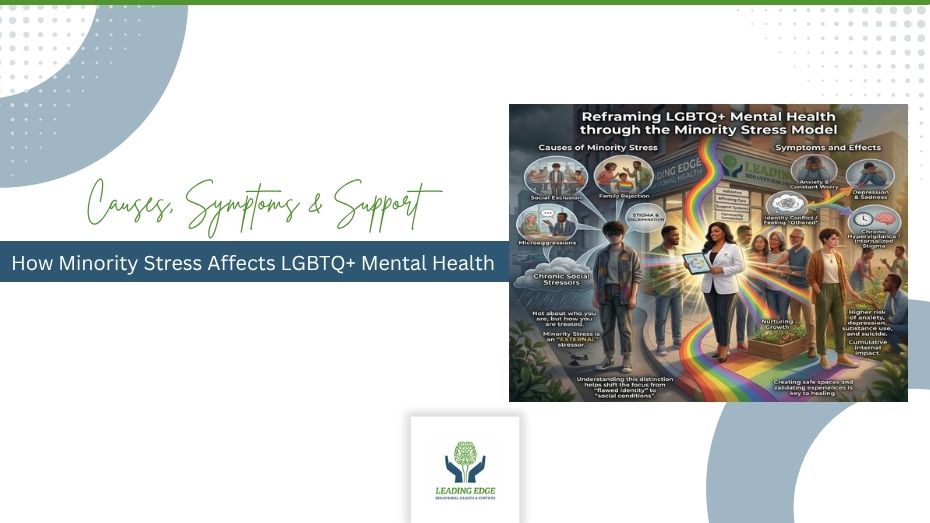
Minority stress is the chronic, identity-related stress that LGBTQ+ people experience as a result of living in a society that often stigmatizes their sexual orientation or gender identity. It isn’t caused by being LGBTQ+ itself it’s caused by the discrimination, rejection, and pressure to hide that so often comes with it. Understanding this distinction matters, because it reframes LGBTQ+ mental health disparities as a response to social conditions rather than a flaw in identity.
This distinction comes from a well-established framework in psychology called the minority stress model, and it helps explain why LGBTQ+ individuals experience higher rates of anxiety, depression, and other mental health concerns than the general population and, more importantly, what actually helps.
What Is Minority Stress? The Minority Stress Model Explained
Minority stress is the excess stress that people from stigmatized social groups experience because of their minority status. The concept was developed by researcher Ilan Meyer, whose minority stress model has become the foundational framework for understanding LGBTQ mental health disparities.
According to the model, LGBTQ+ individuals face two layers of stress on top of the everyday stressors everyone experiences: general stress (job pressure, financial strain, relationship conflict) and minority stress, which is added specifically because of a person’s sexual orientation or gender identity. Over time, this extra, chronic layer of stress wears on the body and mind, contributing to the mental health disparities researchers consistently observe in LGBTQ+ populations.
The model organizes minority stressors into two categories: distal stressors, which come from the outside world, and proximal stressors, which develop inside a person’s own mind in response to those external experiences. Both interact with each other, and both can be chronic meaning the stress doesn’t resolve after a single event but persists as an ongoing psychological burden.
Distal vs. Proximal Stressors: What’s the Difference?
Distal stressors are external, objective events that happen to someone. Proximal stressors are internal, subjective processes of how a person comes to expect, interpret, or internalize those events over time. Distal stress tends to come first; proximal stress often develops as a psychological response to repeated or anticipated distal stress.
Distal (External) Minority Stressors
Distal stressors don’t depend on a person’s private feelings; they’re observable events rooted in the social environment. Common examples include:
- Discrimination, whether in healthcare, housing, or public spaces
- Workplace discrimination, including being passed over for promotion, harassed, or misgendered on the job
- Family rejection, from a parent refusing to use a chosen name to complete estrangement
- LGBTQ+ microaggressions subtle, often unintentional comments or assumptions that signal exclusion
- Verbal harassment or physical violence related to sexual orientation or gender identity
- Structural or legal barriers, such as a lack of nondiscrimination protections
Proximal (Internal) Minority Stressors
Proximal stressors are the psychological responses that build up after repeated exposure to distal stress. They include:
- Internalized stigma absorbing negative societal messages about one’s own identity, sometimes described as internalized homophobia or internalized transphobia
- Identity concealment hiding one’s sexual orientation or gender identity to avoid a negative reaction, which requires ongoing mental effort
- Anticipated discrimination and rejection sensitivity expecting to be judged or excluded, even in neutral situations
- Hypervigilance a heightened, exhausting alertness to potential threat in unfamiliar spaces
- Fear of coming out anxiety tied to disclosing one’s identity to family, friends, or colleagues
Researchers describe proximal stress as the more subjective half of the model: it depends on how a person appraises their environment, shaped by their history of distal experiences. A person doesn’t need to experience overt discrimination every day to feel its effects; the anticipation of it can be its own chronic stressor.
How Minority Stress Affects Transgender and Gender-Diverse Individuals
Gender minority stress follows the same distal-proximal structure but includes stressors specific to gender identity. Distal stressors for transgender and gender-diverse individuals often include non-affirmation being denied recognition of one’s gender by others along with identity-based victimization and barriers to gender-affirming care. Proximal stressors can include internalized transphobia and a persistent fear of being misgendered or outed. Because gender minority stress often intersects with sexual minority stress, transgender individuals who are also sexual minorities may carry a compounded stress burden.
Mental Health Outcomes Linked to Minority Stress
Minority stress doesn’t just cause temporary discomfort sustained exposure is associated with a wide range of mental health outcomes:
- Minority stress and anxiety or depression. The American Psychiatric Association reports that LGBTQ individuals are more than twice as likely to experience a mental health condition in their lifetime compared to heterosexual and cisgender individuals, and roughly 2.5 times more likely to experience depression, anxiety, and substance misuse.
- LGBTQ trauma and PTSD. Repeated discrimination, harassment, or family rejection can function like cumulative traumatic stress, and PTSD symptoms are disproportionately common in LGBTQ+ populations.
- LGBTQ social isolation. Concealment and fear of rejection can lead people to withdraw from relationships, reducing access to the social support that would otherwise buffer stress.
- Shame and low self-esteem. Internalized stigma can quietly erode a person’s sense of self-worth over years.
- Emotional exhaustion and burnout symptoms. The ongoing labor of managing hypervigilance, concealment, and anticipated rejection is genuinely tiring; many LGBTQ+ people describe a kind of chronic fatigue tied to simply navigating daily life.
- Minority stress and suicidal thoughts. National survey data has found meaningfully elevated rates of serious mental illness and suicidal ideation among LGB adults, particularly when combined with a co-occurring substance use disorder.
- Substance use as a coping mechanism. LGBTQ+ individuals report higher rates of alcohol misuse and marijuana use, often as an attempt to manage minority stress rather than as a result of identity itself.
- Sleep problems, frequently tied to chronic hypervigilance or unresolved anxiety.
It’s worth repeating: none of these outcomes stem from being LGBTQ+. They stem from the stress of navigating stigma, rejection, and discrimination a distinction supported by decades of minority stress research.
Signs You May Be Experiencing Minority Stress
Minority stress can be easy to normalize, since it often builds gradually. Some signs worth paying attention to include:
- Feeling constantly “on guard” in new or unfamiliar environments
- Exhaustion after spending time concealing your identity or code-switching
- Persistent worry about how others will react if they learn your identity
- Difficulty trusting that relationships or workplaces are genuinely safe
- A pattern of avoiding certain places, people, or conversations out of anticipated rejection
- Increased reliance on alcohol, cannabis, or other substances to relax or cope
- Trouble sleeping, low motivation, or a general sense of emotional depletion
Recognizing these patterns is not a diagnosis but it can be a useful starting point for deciding whether additional support might help.
How to Cope With Minority Stress: Building Resilience
Minority stress research also points to protective factors that can meaningfully reduce its impact. Coping strategies that tend to help include:
- Chosen family and community connection. Strong ties to LGBTQ+ community and chosen family are consistently associated with better mental health outcomes, in part because they counter the isolation that minority stress can create.
- Selective disclosure. Choosing where, when, and to whom to come out rather than concealing identity everywhere or disclosing indiscriminately can reduce the psychological cost of concealment while still managing safety.
- Identity pride and positive identity development. A secure, positive sense of LGBTQ+ identity can act as a buffer against internalized stigma.
- Boundary-setting. Limiting time with people or environments that are reliably invalidating, when possible, reduces repeated exposure to distal stress.
- Peer support and support groups. Talking with others who understand minority stress firsthand can reduce the isolating effect of “no one else gets it.”
- Basic self-care fundamentals. Sleep, movement, and nutrition don’t resolve minority stress, but they support the nervous system’s capacity to handle it.
Coping strategies help, but they aren’t a substitute for professional support when symptoms are persistent or significantly affecting daily life.
Can Affirming Therapy Help With Minority Stress?
Yes. LGBTQ-affirming therapy is specifically designed to address the psychological processes described in the minority stress model, and a growing body of clinical research supports its effectiveness. LGBTQ-affirmative cognitive behavioral therapy (CBT), for example, has been studied in multiple clinical trials and has shown reductions in depression, anxiety, and minority stress mechanisms such as internalized stigma and identity concealment.
What makes affirming and trauma-informed LGBTQ+ care different from generic treatment is that it explicitly validates identity-related distress as a normal response to stigma not a personal or clinical flaw while helping patients build cognitive flexibility, assertiveness, and stronger social support. This approach treats the stress, not the identity, as the target of care.
When to Seek Professional Help
It’s reasonable to consider professional support when minority stress symptoms are persistent, escalating, or interfering with work, relationships, or daily functioning for example, ongoing depression or anxiety, worsening substance use, or a growing sense of hopelessness. Minority stress is not the same as everyday stress: it is chronic, identity-linked, and shaped by an ongoing social context rather than a single passing event, which is part of why it often benefits from structured, professional support rather than time alone.
If you or someone you know is having thoughts of suicide, immediate support is available through the 988 Suicide & Crisis Lifeline (call or text 988) or The Trevor Project (1-866-488-7386), which specializes in crisis support for LGBTQ+ young people.
LGBTQ+ Affirming Mental Health Support in Texas
Leading Edge Behavioural Health Services provides LGBTQ+ affirming mental health care through telepsychiatry for eligible patients across Texas, including areas such as Conroe, as well as in Arizona, New Mexico, and Vermont. Care is provided by Dr. Oluwatobi, a board-certified Psychiatric Mental Health Nurse Practitioner (PMHNP-BC) with more than 11 years of experience across private and community mental health settings. Services include psychiatric evaluation, medication management, and affirming, individualized support for the anxiety, depression, and other outcomes that minority stress can contribute to along with related support for substance use concerns when relevant. Care is delivered remotely, making it more accessible for patients seeking an LGBTQ-affirming provider without needing an in-person visit.
Frequently Asked Questions
What is minority stress in the LGBTQ community?
Minority stress is the additional, chronic stress LGBTQ+ individuals experience as a result of stigma, discrimination, and the pressure to conceal their identity on top of the everyday stress everyone faces.
What are examples of LGBTQ minority stress?
Examples include family rejection, workplace discrimination, microaggressions, internalized stigma, fear of coming out, and hypervigilance in unfamiliar environments.
What is the difference between proximal and distal stress?
Distal stressors are external, observable events like discrimination or harassment. Proximal stressors are internal psychological responses, such as internalized stigma or anticipated rejection, that often develop after repeated distal stress.
Can minority stress cause anxiety or depression?
Minority stress is strongly associated with elevated rates of anxiety and depression in LGBTQ+ populations, though individual experiences and other contributing factors vary.
How can LGBTQ individuals cope with minority stress?
Helpful strategies include building connections with chosen family and LGBTQ+ community, setting boundaries with invalidating environments, practicing selective disclosure, and seeking peer or professional support.
Can affirming therapy help with minority stress?
Yes. LGBTQ-affirmative therapy approaches, including affirmative CBT, are designed to directly address minority stress mechanisms and have shown positive results in clinical research.
When should someone seek professional help?
Consider professional support when symptoms are persistent, worsening, or interfering with daily life including ongoing anxiety or depression, increasing substance use, or thoughts of self-harm.
Getting Support
Minority stress is a well-documented, research-backed explanation for LGBTQ+ mental health disparities not a reflection of anything being “wrong” with LGBTQ+ identity itself. If minority stress is affecting your daily life, relationships, or overall well-being, affirming psychiatric support can help you address the anxiety, depression, or other symptoms it contributes to. Schedule a consultation with Leading Edge Behavioural Health Services to learn more about LGBTQ+ affirming telepsychiatry care.